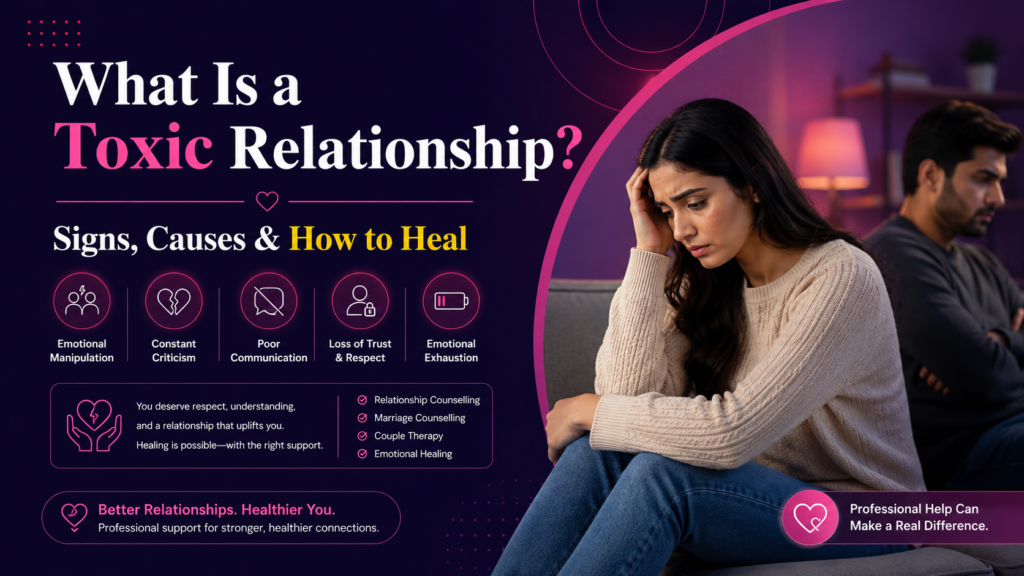
What Is a Toxic Relationship?
Signs, Causes & How to Heal
A deeply informative guide to understanding toxic relationships — the warning signs, hidden causes, emotional impact, and how professional relationship counselling and marriage counselling at Shweta Heals helps you break the cycle and rebuild your life.
Toxic relationships do not always begin with obvious red flags. Often they start with intensity, passion, and deep emotional connection — and shift, almost imperceptibly, into patterns that erode your sense of self, your confidence, and your capacity for genuine happiness. Understanding what a toxic relationship is, recognising its signs early, and knowing that professional relationship counselling and marriage counselling can genuinely help — these are the foundations of healing and lasting change.
What Is a Toxic Relationship?
Defining the patterns that distinguish a toxic relationship from a merely difficult one
A toxic relationship is any personal, romantic, or marital relationship in which consistent patterns of behaviour cause one or both individuals to feel emotionally unsafe, disrespected, manipulated, controlled, or persistently diminished. The word “toxic” in this context refers to the cumulative, erosive effect that these patterns have on a person’s sense of self, mental health, and overall wellbeing.
What makes a toxic relationship different from a simply difficult or challenging one is the pattern. All relationships experience conflict, stress, and rough periods. In a healthy relationship, these difficulties are worked through with mutual respect, genuine effort, and care for each other’s emotional safety. In a toxic relationship, the same harmful patterns repeat — criticism, manipulation, control, dishonesty — without genuine accountability or change.
Toxic relationships can exist in marriages, romantic partnerships, friendships, and even family dynamics. In the context of Indian families in cities like Faridabad, Delhi, and Delhi NCR — where social pressure to maintain relationships and marriages is significant — many individuals endure toxic relationship patterns for years without recognising them as harmful, or without knowing that professional support is available.
“A relationship that consistently costs you your peace, your self-worth, and your sense of who you are — is not love. It is a pattern that deserves to be understood, addressed, and healed.”Shweta Mittal — Counsellor & Founder, Shweta Heals, Faridabad
Warning Signs of a Toxic Relationship
Recognising the patterns before they cause irreversible emotional damage
One of the most challenging aspects of toxic relationships is that the signs are often gradual and subtle at first — becoming more pronounced over time as the dynamic becomes more entrenched. Here are the key warning signs that your relationship may be toxic:
Constant Criticism and Belittling
Your partner regularly criticises you, belittles your achievements, mocks your opinions, or makes you feel fundamentally inadequate.
Gaslighting and Manipulation
You are made to question your own memory, perceptions, and feelings — leaving you confused, doubting your own reality, and dependent on your partner’s version of events.
Isolation from Support Systems
You are gradually cut off from friends and family — either directly by your partner, or indirectly through guilt, jealousy, and demands on your time and loyalty.
Walking on Eggshells
You consistently monitor your words, expressions, and behaviour out of fear of triggering your partner’s anger, disappointment, or emotional withdrawal.
Jealousy and Possessiveness
Extreme jealousy presented as love — monitoring your movements, demanding access to your phone, and treating normal social interactions as threats.
Emotional Exhaustion
The relationship consistently drains your energy, leaves you feeling empty, anxious, or emotionally spent, rather than nurtured, supported, and recharged.
Lack of Respect and Contempt
Persistent disrespect, contempt, eye-rolling, mockery, or dismissiveness — an attitude that communicates that you are fundamentally unworthy of genuine consideration.
One-Sided Effort and Accountability
You consistently invest emotionally, practically, and with your time while your partner contributes little — and takes no genuine accountability for their role in recurring problems.
If you recognise three or more of these signs as consistent patterns in your relationship, professional relationship counselling is strongly recommended. Early intervention consistently produces significantly better outcomes than waiting until the damage to both parties is more severe.
What Causes Toxic Relationships to Develop?
Understanding the roots that allow toxic patterns to take hold
Toxic relationships rarely develop overnight. They are shaped by a complex interplay of individual histories, attachment patterns, communication skills, and relational dynamics that evolve over time. Understanding the causes is a critical step toward genuine healing — because addressing symptoms without understanding their roots rarely creates lasting change.
Unresolved Past Trauma
Personal trauma from childhood, previous relationships, or significant losses shapes how individuals behave and respond within intimate relationships — often unconsciously recreating familiar patterns.
Insecure Attachment Styles
Anxious, avoidant, or disorganised attachment patterns — developed in early childhood — create the relational blueprints through which individuals navigate intimacy, trust, and conflict.
Poor Communication Patterns
Inability to express needs clearly, difficulty setting boundaries, and reactive rather than reflective communication allow misunderstandings and resentments to accumulate without resolution.
Low Self-Worth
Individuals who do not believe they deserve respect and care are more likely to accept — and normalise — harmful treatment as simply what relationships are.
Unhealthy Relationship Models
Growing up in a household with unhealthy relationship dynamics normalises those patterns — making them feel familiar and therefore, unconsciously, like “home.”
Unaddressed Mental Health Concerns
Untreated anxiety, depression, personality disorders, or trauma responses can significantly distort how individuals perceive and behave within intimate relationships.
The Emotional and Psychological Impact of a Toxic Relationship
How toxicity quietly damages mental health, self-worth, and life quality over time
The psychological impact of remaining in a toxic relationship is cumulative, profound, and often underestimated by the individuals experiencing it — particularly because the gradual nature of the damage makes it difficult to recognise in real time. Many individuals in Faridabad, Delhi, and Delhi NCR carry the effects of toxic relationship patterns silently, not understanding why they feel increasingly anxious, small, and emotionally numb.
Chronic Anxiety
Persistent hypervigilance and anxiety — always waiting for the next criticism, argument, or emotional withdrawal.
Depression
Persistent sadness, emotional flatness, hopelessness, and withdrawal from previously meaningful activities and relationships.
Eroded Self-Worth
A deeply diminished sense of personal value, capability, and the belief that one deserves better treatment or a happier life.
Loss of Identity
Gradual disconnection from personal interests, values, and sense of self as the relationship consumes increasing psychological space.
Difficulty Trusting
Deep difficulties trusting others in future relationships as a direct result of the manipulation, dishonesty, and betrayal experienced.
Work & Life Impact
Toxic relationship stress consistently spills into professional performance, physical health, sleep quality, and overall life satisfaction.
The effects of toxic relationship trauma do not automatically disappear when the relationship ends. Without professional support, these patterns of anxiety, low self-worth, and distorted relational expectations can persist — and even be carried into future relationships. This is exactly why professional counselling is so valuable: it addresses not just the present situation, but the deeper patterns that require healing for lasting freedom.
How Relationship Counselling and Marriage Counselling Help
The transformative role of professional therapeutic support in healing and recovery
Whether you are in a toxic relationship and want to understand what is happening, trying to decide whether to repair or leave, or healing from one you have already exited — professional relationship counselling at Shweta Heals offers structured, compassionate, and deeply personalised support that creates genuine change.
For couples where both partners genuinely want to address the toxic patterns and rebuild a healthier relationship dynamic, marriage counselling provides the professional environment and guidance needed to do this work safely and effectively. As explored in our guide on why trust issues destroy relationships and how therapy can help, the roots of toxic dynamics are consistently more tractable with professional support than without it.
For individuals who have left — or are leaving — a toxic relationship, individual counselling focuses on processing the emotional residue, rebuilding self-worth, understanding the patterns that contributed to the dynamic, and developing the emotional tools needed for genuinely healthier future relationships. Read more in our blog on how couple counselling can save a relationship before divorce and our guide on professional married couple counselling in Faridabad.
The Healing Journey — Step by Step
How Shweta Mittal at Shweta Heals guides individuals and couples through recovery
Recognition and Awareness
The first and often most challenging step — naming what has been happening. Many individuals in Faridabad and Delhi NCR have normalised toxic patterns over years. In counselling, Shweta Mittal creates a safe, non-judgmental space where individuals can begin to see their situation clearly, without minimisation or shame, for possibly the first time.
Understanding the Roots
Toxic relationship patterns are not random — they have specific emotional roots in both individuals’ histories, attachment styles, and psychological needs. Understanding why the dynamic developed is essential for genuine, lasting change — whether that change involves transforming the existing relationship or ensuring healthier patterns in future ones.
Emotional Processing and Healing
Processing the anger, grief, shame, and confusion that toxic relationships generate is essential. Without this processing, these emotions remain active — influencing perceptions, decisions, and future relationships in ways the individual may not consciously recognise. Counselling provides the structured support needed for this deep emotional work to happen safely.
Rebuilding Self-Worth and Personal Boundaries
Perhaps the most transformative part of the healing journey — reconnecting with your inherent worth, reclaiming your sense of identity, and developing the practical understanding of healthy personal boundaries that protects you in all future relationships. Shweta Mittal places this at the centre of the recovery process.
Communication Skills and Healthy Patterns
Learning and practising genuinely healthy communication — honest, boundary-respecting, emotionally intelligent communication — gives individuals and couples the practical tools they need to sustain healthier dynamics going forward, rather than reverting to familiar but harmful patterns.
Long-Term Emotional Independence and Resilience
The ultimate goal is genuine emotional independence — the capacity to recognise toxic patterns early, trust your own perceptions, maintain your self-worth, and choose relationships that are genuinely nourishing. This is not just recovery; it is the foundation of a permanently healthier relational life.
Why Choose Shweta Mittal at Shweta Heals
Gold Medalist MSW — Uniquely Qualified
Gold Medalist in Masters of Social Work with a strong foundation in law — combining academic distinction with deep practical expertise across schools, colleges, hospitals, and corporates.
5,00,000+ Sessions of Proven Impact
Over 5,00,000 counselling sessions conducted, 1,00,000+ marriages saved — a decade of proven therapeutic impact across Faridabad and Delhi NCR.
Completely Personalised — No Generic Advice
Every counselling plan at Shweta Heals is built specifically around each individual’s unique situation, history, and goals. No templates, no shortcuts.
100% Confidential and Safe
Absolute confidentiality in every session — creating the genuine psychological safety essential for honest, productive therapeutic work.
Trusted Female Counsellor
Many individuals — particularly women navigating difficult relationship situations — feel significantly more comfortable with a trusted female counsellor who combines professional expertise with genuine empathy.
Online and Offline — Maximum Flexibility
Both in-person sessions at the Faridabad clinic and online sessions across India, offering the same professional quality with maximum accessibility and convenience.
Online & Offline Relationship Counselling
In-Person — Faridabad
- Face-to-face sessions at Sector 12 clinic
- Complete physical privacy
- Ideal for complex or long-term situations
- Walk-in and appointment sessions
- Faridabad, NIT, Ballabhgarh, Badarpur, NCR
Online — Pan India
- Attend from home — no travel required
- Equally effective professional quality
- Flexible scheduling — evenings and weekends
- Available across all of India
- Complete privacy from home environment
Other Counselling Services at Shweta Heals
Marriage Counselling
Expert support for married couples facing communication breakdown, trust issues, or emotional distance.
Stress & Anxiety Counselling
Professional therapeutic support for anxiety, overthinking, and emotional exhaustion caused by relationship stress.
Career Counselling
Expert career guidance for students after 10th & 12th and professionals navigating important transitions.
Individual & Couple Counselling
Personalised support for individuals and couples at any relationship stage — married, unmarried, or pre-marital.
Areas Served
Visit or Contact Shweta Heals
Confidential relationship counselling — in-person in Faridabad & online across India
Conclusion
A toxic relationship is not a reflection of your worth — it is a pattern that developed, that can be understood, and that with the right support can be genuinely healed or moved beyond. Recognising the signs, understanding the causes, and knowing that professional help is available are the most important first steps.
Shweta Mittal at Shweta Heals has spent over a decade helping individuals and couples across Faridabad, Delhi, and Delhi NCR navigate exactly this terrain — with expertise, empathy, and a proven approach that creates real, lasting change. Whether you need individual support to heal and grow, or couples counselling to rebuild a genuinely different relationship, professional guidance is available — online across India and in-person in Faridabad.
You deserve a relationship that makes you feel safe, valued, and genuinely yourself. Reach out today — your first conversation is completely free and confidential.
Related Reading
Why Trust Issues Destroy Relationships and How Therapy Can Help
MarriageHow Couple Counselling Can Save a Relationship Before Divorce
CounsellingProfessional Married Couple Counselling in Faridabad
FaridabadAffordable Couple Counselling in Faridabad Near You
Ready to Break Free and Heal?
Book a confidential relationship counselling or marriage counselling session with Shweta Mittal — in-person in Faridabad or online across India.
Frequently Asked Questions
Clear, honest answers about toxic relationships and how professional counselling helps
A toxic relationship is any personal, romantic, or marital relationship in which one or both individuals consistently feel drained, disrespected, manipulated, or emotionally unsafe. Toxicity may stem from patterns of control, emotional abuse, constant criticism, dishonesty, jealousy, or a persistent imbalance of power that erodes one or both people’s wellbeing and self-worth over time.
Common signs include constant criticism and belittling, emotional manipulation and gaslighting, jealousy and possessiveness, consistent disrespect, lack of trust, frequent explosive arguments, feeling emotionally drained or anxious, walking on eggshells around your partner, isolation from friends and family, and one-sided effort where only one person invests in the relationship.
Toxic relationships develop through a combination of factors including unresolved personal trauma, insecure attachment styles, poor communication patterns, unaddressed mental health concerns, unhealthy childhood relationship models, power imbalances, substance issues, and the gradual normalisation of harmful behaviours that erode mutual respect over time.
Yes — in many cases. Healing a toxic relationship requires both individuals to genuinely acknowledge the harmful patterns, commit to change, and engage in professional counselling support. When both partners are willing and the toxicity has not progressed to irreversible emotional harm, relationship counselling and marriage counselling can create meaningful transformation.
Toxic relationships cause significant mental health damage including chronic anxiety, depression, PTSD-like symptoms, low self-esteem and worthlessness, emotional exhaustion, trust difficulties, and a persistent sense of walking on eggshells. Over time, the cumulative psychological impact of a toxic relationship can affect every area of life including work, physical health, and other relationships.
All relationships go through difficult periods — conflict, stress, and misunderstanding are normal. A difficult relationship has friction but retains mutual respect and genuine care. A toxic relationship, by contrast, involves consistent patterns of emotional harm, disrespect, manipulation, or control that make one or both individuals feel persistently unsafe, diminished, or exhausted. The key difference is the pattern and the presence of genuine harm.
Gaslighting is a form of psychological manipulation in which one person causes another to question their own perceptions, memories, feelings, and reality. Common examples include denying that events occurred, reframing situations to shift blame, minimising the other person’s emotional reactions, and persistently suggesting the other person is too sensitive or confused. Gaslighting is a significant marker of a toxic relationship.
Yes. Relationship counselling provides a structured, professionally guided space where harmful patterns can be safely identified, understood, and addressed. A trained counsellor like Shweta Mittal at Shweta Heals helps couples understand the roots of toxic dynamics, develop healthier communication tools, rebuild trust, and — where genuine mutual commitment exists — transform the relationship into a healthier one.
Seek counselling as soon as you recognise persistent patterns of emotional harm, manipulation, or toxicity in your relationship. Early intervention produces significantly better outcomes. If arguments are frequent and unresolved, communication has broken down, you feel emotionally unsafe or controlled, or you are experiencing anxiety or depression related to your relationship, professional support is the right next step.
Not always — but protecting your emotional and physical safety always is. Whether the right path is healing the relationship through professional counselling or safely leaving it depends on the specific nature and severity of the toxicity, the willingness of both partners to change, and whether genuine safety is present. A professional counsellor can help you evaluate your specific situation without judgment.
Unresolved toxic relationship trauma creates patterns that can follow individuals into future relationships — including hypervigilance, difficulty trusting, emotional shutdown, and unconsciously recreating familiar but harmful dynamics. Professional trauma counselling helps individuals process these wounds, break the cycle, and develop the emotional tools needed for genuinely healthy future connections.
Emotional abuse involves consistent patterns of behaviour designed to control, manipulate, demean, or destabilise another person’s emotional state and sense of self. It includes persistent criticism, humiliation, threats, isolation, gaslighting, and emotional withdrawal as punishment. Emotional abuse leaves deep psychological wounds and is a central feature of toxic relationships.
Yes. Marriage counselling at Shweta Heals provides professional support for couples experiencing toxic patterns within marriage. When both partners are committed to change, Shweta Mittal helps them identify the specific harmful dynamics at play, develop healthy communication strategies, rebuild emotional safety and trust, and create a genuinely different relationship dynamic going forward.
Healing is deeply individual and depends on the severity and duration of the toxic relationship, the individual’s support system, and whether professional therapeutic support is accessed. With professional counselling, most individuals begin to experience meaningful emotional relief and clarity within several sessions. Full recovery and the development of new healthy relationship patterns typically unfolds over a longer, individualised journey.
Low self-worth is both a contributing factor to entering toxic relationships and a consequence of remaining in them. Individuals who do not believe they deserve better are more likely to accept harmful treatment as normal. Conversely, remaining in a toxic relationship progressively erodes self-worth. Rebuilding self-worth through professional counselling is central to both ending and healing from toxic relationship patterns.
Yes. Shweta Heals offers both online and offline counselling sessions. Online sessions are available for individuals and couples across Faridabad, Delhi, Delhi NCR, Badarpur, Ballabhgarh, and all of India — with the same professional quality, confidentiality, and personalised approach as in-person sessions.
Visit shwetaheals.com/contact, fill in the contact form, or call +91 8587998559. In-person sessions are available at Space Center, Tf-01, 3rd Floor, Parsvnath City Mall, Sector 12, Faridabad-121007. Online sessions are available across India. Your first enquiry is completely free and confidential.