How Acceptance & Commitment Therapy Helps With Depression
What if the answer to depression is not fighting your thoughts harder, but learning to live meaningfully alongside them? Ms. Shweta Mittal at Shweta Heals explains how ACT offers a different, values-guided path through depression.
01When Trying Harder Makes Depression Worse
A reflection from Ms. Shweta Mittal on why depression responds to a different kind of effort
“I have tried everything. I tell myself to think positively. I know these thoughts are not real. But nothing I do makes them stop.”
This is something I hear often in depression counselling sessions at Shweta Heals — from people who are not passive about their depression, but have been fighting it intensely and still feel stuck. The exhaustion in that statement is real. And it points to something important: for many individuals, the strategy of battling depressive thoughts directly, of trying harder to think differently or feel better, is itself part of what keeps the depression in place.
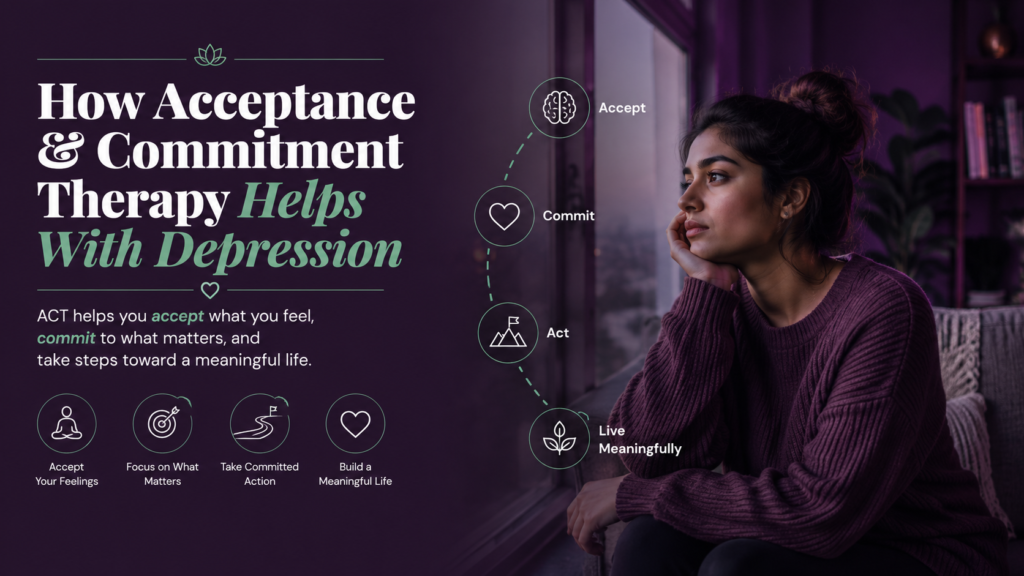
Acceptance and Commitment Therapy, widely known as ACT, offers a genuinely different approach. Not passivity. Not giving up. But a fundamentally different relationship with difficult thoughts and feelings — one that reduces their power not by winning arguments with them, but by choosing to live meaningfully regardless of them.
Acceptance and Commitment Therapy helps with depression by targeting the experiential avoidance and psychological inflexibility that sustain it. Where depression involves fusing with negative thoughts, withdrawing from life, and losing connection with what matters most, ACT addresses each of these directly — teaching individuals to hold their thoughts more lightly, reconnect with their core values, and commit to purposeful action even when difficult feelings are present. This makes ACT a powerful approach within depression counselling, both alongside and as a complement to CBT-based methods at Shweta Heals Faridabad.
“In depression, the mind often says ‘wait until you feel better before you start living again.’ ACT gently turns that around — start living by your values now, and feeling better tends to follow the living.”Ms. Shweta Mittal — Depression & Anxiety Counsellor, Shweta Heals, Faridabad
02What Is Acceptance and Commitment Therapy?
Understanding the approach before exploring how it applies to depression
Acceptance and Commitment Therapy is an evidence-based form of therapy developed from behavioural science, integrating mindfulness principles with a clear focus on personal values and committed action. Its name captures its two primary movements: accepting what is within a person’s inner experience that cannot be immediately changed, and committing to actions guided by what genuinely matters.
Unlike approaches that ask a person to challenge and change their thoughts directly, ACT teaches individuals to change their relationship with thoughts — observing them with curiosity rather than treating every negative thought as a command to obey or an emergency to resolve. This is called psychological flexibility, and building it is the central aim of all ACT work in depression counselling and anxiety counselling.
ACT is not about eliminating difficult thoughts or feelings. It is about changing how much power those thoughts and feelings have over a person’s choices and behaviour — so life can move forward even while the mind is still producing difficult content.
03The Six Core ACT Processes in Depression Counselling
What each process addresses in the context of depression specifically
Acceptance
Opening up to difficult thoughts and feelings without struggling against them — freeing the energy consumed by that struggle for meaningful action instead.
Cognitive Defusion
Observing thoughts as mental events rather than facts — “I am having the thought that I am worthless” rather than “I am worthless.” Reduces the grip of depressive thinking.
Present-Moment Awareness
Anchoring attention in the present rather than being lost in depressive rumination about the past or anxious worry about the future.
Self-as-Context
Recognising that you are the observer of your thoughts, not the thoughts themselves — a stable, broader sense of self that depression cannot fully reach.
Values Clarification
Identifying what genuinely matters most — relationships, creativity, contribution, growth — and using these as a compass for daily choices even when motivation is low.
Committed Action
Taking consistent, purposeful steps guided by personal values, even in the presence of difficult feelings — rather than waiting to feel better first.
04Why ACT Is Particularly Well-Suited to Depression
The specific mechanisms of depression that ACT addresses directly
Depression is not just sad thinking. It involves a cluster of patterns that reinforce each other — and ACT addresses several of the most central ones in ways that differ meaningfully from other approaches used in depression counselling.
The first is cognitive fusion — in depression, negative thoughts about the self, the world, and the future tend to feel completely, overwhelmingly true. “Nothing will ever get better” does not feel like a thought; it feels like a fact about reality. ACT’s defusion techniques reduce the conviction of these thoughts without requiring a person to argue them away, which often feels impossible during depressive episodes. For a deeper look at how depression affects thinking, see our guide on Understanding Depression — Signs, Causes and the Power of Therapy.
The second is experiential avoidance — the tendency to withdraw from activities, relationships, and situations to avoid the emotional pain they might trigger. In the short term, avoidance provides relief; in the longer term, it sustains and deepens depression by cutting off the very sources of meaning and connection that recovery depends on. ACT’s values and committed action components specifically counter this pattern.
The third is loss of connection with values — depression typically disconnects individuals from what matters most to them, leaving a grey, purposeless quality to daily life. Reconnecting with clearly identified personal values, and taking even small steps toward them, is one of the most direct routes out of the withdrawal cycle that sustains depression.
What Depression Asks vs. What ACT Asks
Depression typically asks a person to wait — wait until the mood lifts, until the thoughts quiet, until motivation returns — before re-engaging with life. This waiting can go on for months or years, because the conditions for returning never arrive while withdrawal continues.
ACT asks a different question entirely: what small step, however imperfect and however uncomfortable, aligns with what actually matters to you? Taking that step, guided by values rather than mood, is often what creates the first genuine crack in a persistent depressive pattern.
05ACT vs CBT — Two Different Paths Through Depression
Understanding how they differ helps clarify which approach best suits each individual
Both ACT and CBT are evidence-based and effective in depression counselling. The difference lies in how each approach handles negative thoughts. Our detailed guide on How CBT Helps Manage Stress and Negative Thinking explains the CBT approach in full. The comparison below shows where they differ in practice.
ACT Approach
- Changes the relationship with thoughts rather than the thoughts themselves
- Teaches defusion — observing thoughts as thoughts, not facts
- Uses acceptance of difficult feelings to reduce their power
- Values and committed action drive recovery forward
- Present-moment awareness counters rumination
- Works well when direct thought-challenging feels impossible or forced
CBT Approach
- Directly challenges and restructures unhelpful thought patterns
- Uses thought records to examine evidence for and against beliefs
- Cognitive restructuring builds more realistic thinking
- Behavioural activation increases engagement with rewarding activity
- Structured, skills-based sessions with clear homework
- Works especially well when specific thought distortions are identifiable
In practice at Shweta Heals, Ms. Shweta Mittal draws on both ACT and CBT within depression counselling, selecting the approach — or combination — that best matches each individual’s specific patterns, preferences, and stage of recovery. You can also read our guide on How Therapy Helps Depression Recovery for a broader perspective on what the recovery process involves.
06What ACT Looks Like in a Depression Counselling Session
Practical exercises and what they feel like in real counselling
-
1Defusion exercises: Learning to observe thoughts rather than inhabit them — for example, prefacing a painful thought with “I notice I am having the thought that…” which creates just enough distance to reduce its command over behaviour.
-
2Values clarification work: Identifying what genuinely matters — not goals or achievements, but the qualities of living that feel meaningful. These become the compass for small, consistent committed actions even during low mood.
-
3Mindful present-moment exercises: Practising returning attention to the present experience — breath, physical sensation, immediate surroundings — interrupting the ruminative loops that depression sustains.
-
4Self-as-context exploration: Recognising the difference between the observing self (stable, continuous, cannot be broken by depression) and the content of thoughts and feelings (temporary, variable, not the whole self).
-
5Committed action planning: Identifying one small, values-guided step to take before the next session — not because motivation is present, but because the step matters regardless of how it feels to take it.
A common misconception worth addressing directly: Acceptance in ACT is not the same as resignation, giving up, or approving of being depressed. It means opening up to difficult feelings without unnecessary additional struggle, so that energy is available for meaningful, values-guided living rather than exhausted by the battle with the depression itself.
07Counselling Services at Shweta Heals
Professional support across depression, anxiety, relationships, and more
Depression Counselling
ACT and CBT-based support for depression, low mood, withdrawal, and loss of meaning. Read our complete guide on how therapy helps depression recovery.
Anxiety Counselling
Evidence-based anxiety counselling for worry, panic, social anxiety, and stress. Read our guide on the best therapist for anxiety in Faridabad.
Stress & Mindfulness
ACT and mindfulness-based approaches for chronic stress, burnout, and emotional overwhelm in daily life.
Marriage Counselling
For couples where one or both partners are navigating depression or anxiety that is affecting their relationship.
Relationship Counselling
For individuals and couples where depression or emotional withdrawal is creating distance and disconnection.
Career Counselling
For work-related low mood, burnout, loss of purpose, and the values-disconnection that often accompanies career uncertainty.
08What Clients Share
Real experiences from individuals across Faridabad who found a different path through depression
“I had been waiting to feel better before doing anything. ACT showed me that I had it backwards. Starting to act by my values — even small steps — was what made me feel better over time.”
“The defusion exercises felt strange at first. But learning to see ‘I am having the thought that I am a failure’ instead of just ‘I am a failure’ genuinely changed how much those thoughts controlled me.”
“Values clarification was the part that surprised me most. Understanding what I actually care about — not what I thought I should care about — gave me a real direction through the fog of depression.”
“Online depression counselling from Badarpur, and it was every bit as effective as I hoped. The combination of ACT and CBT approaches felt tailored rather than one-size-fits-all.”
09Related Reading
More helpful guides from Shweta Heals on depression, anxiety & mental health
How Therapy Helps Depression Recovery
How CBT Helps Manage Stress & Negative Thinking
Best Therapist for Anxiety in Faridabad
Understanding Depression — Signs, Causes & Therapy
Depression vs Sadness — What Is the Difference?
What Happens During an Anxiety Attack?
Coping With Suicidal Thoughts — How Timely Support Helps
How to Rebuild Emotional Closeness in a Relationship
10Where We Serve
Faridabad (Sector 12)
Walk-in & appointment sessions at Parsvnath City Mall
NIT Faridabad
Depression & anxiety counselling sessions
Old Faridabad
In-person and online sessions available
Ballabhgarh
In-person or online ACT-based counselling
Badarpur
Online & in-person sessions for Badarpur area
Delhi NCR & Pan India
Online counselling anywhere in India
Visit Shweta Heals — Book a Depression or Anxiety Counselling Session
In-person & online ACT and CBT-based depression counselling and anxiety counselling — Faridabad, Delhi NCR & all of India. First enquiry is completely free.
11Conclusion — A Different Kind of Freedom From Depression
Depression is not a problem that yields entirely to willpower or positive thinking. It often requires a different approach — one that stops fighting the same battle harder and instead changes the terrain entirely. Acceptance and Commitment Therapy offers exactly that: not a promise to eliminate difficult thoughts, but a practical, values-guided path to living meaningfully even while the mind is still producing them.
Whether you are experiencing depression for the first time or have been navigating it for years, ACT-based depression counselling at Shweta Heals offers a structured, compassionate, evidence-based approach that can genuinely shift the pattern. Read more about how therapy supports depression recovery in our guide: How Therapy Helps Depression Recovery. If anxiety is also present, see our page: Best Therapist for Anxiety in Faridabad.
Ms. Shweta Mittal and the team at Shweta Heals are here to help — through in-person sessions at Parsvnath City Mall, Sector 12, Faridabad, and online sessions across India. Reach out today — the first conversation is completely free and entirely confidential.
You Do Not Have to Wait to Feel Better Before Living Better
Book a depression counselling or anxiety counselling session with Ms. Shweta Mittal — in person at Sector 12 Faridabad or online across India. First enquiry is completely free.
?Frequently Asked Questions
Real questions about ACT and depression counselling at Shweta Heals Faridabad.
Acceptance and Commitment Therapy, or ACT, is an evidence-based form of psychotherapy that focuses on developing psychological flexibility — the ability to be present with difficult thoughts and feelings without letting them control behaviour. Rather than eliminating negative thoughts, ACT teaches individuals to observe them with distance, accept what cannot be immediately changed, and commit to actions guided by their core personal values. It is widely used in depression counselling and anxiety counselling at Shweta Heals.
ACT helps with depression by targeting experiential avoidance and psychological inflexibility that sustain it. It teaches individuals to hold their thoughts more lightly through defusion, reconnect with core values, and commit to purposeful action even when difficult feelings are present — rather than waiting to feel better before re-engaging with life.
Psychological flexibility is the central goal of ACT — the capacity to be present, open to experience, and act in alignment with one’s values even when difficult thoughts and feelings exist. In depression, this flexibility collapses: individuals fuse with negative thoughts and withdraw from valued activities. Rebuilding it allows meaningful functioning during recovery rather than waiting for symptoms to fully resolve.
Cognitive defusion creates distance between a person and their thoughts — observing thoughts as mental events rather than facts. In depression, thoughts like “I am worthless” feel completely true. Defusion helps individuals recognise “I am having the thought that I am worthless,” which reduces the thought’s emotional power without needing to argue it away.
Values clarification is one of ACT’s most powerful components. Depression typically disconnects individuals from what matters most. ACT helps identify core personal values clearly and use them as a compass for committed action — even in low mood. This re-engagement with meaningful activity is one of the most direct routes out of the withdrawal cycle that sustains depression.
Yes. CBT focuses on identifying and changing unhelpful thought patterns through cognitive restructuring. ACT does not primarily aim to change thoughts but to change the individual’s relationship with them — developing acceptance and defusion rather than direct challenge. Read our full guide: How CBT Helps Manage Stress & Negative Thinking. Ms. Shweta Mittal draws on both within depression counselling based on each person’s specific needs.
The six core ACT processes are: acceptance, cognitive defusion, present-moment awareness, self-as-context, values clarification, and committed action. In depression counselling, each is addressed in a personalised way based on the individual’s specific patterns and recovery goals.
Yes. ACT is particularly well-suited to addressing depression and anxiety counselling when they co-occur, which is common. The same core processes — acceptance, defusion, values-based action, and present-moment awareness — apply to both conditions, making it a unified framework.
ACT is broadly effective across different presentations of depression, including persistent low mood, loss of motivation, emotional numbness, and depression associated with grief or life transitions. For severe clinical depression, ACT is typically part of a broader treatment plan. Ms. Shweta Mittal assesses each individual’s situation to determine the most appropriate approach.
Most individuals notice meaningful shifts within 8 to 15 sessions of ACT-based depression counselling, though the timeline varies based on severity and individual circumstances. Ms. Shweta Mittal creates a personalised plan rather than following a fixed timeline.
Acceptance in ACT does not mean resignation or giving up. It means opening up to difficult thoughts and feelings without struggling against them unnecessarily, freeing energy for meaningful, values-guided action. In depression counselling, this distinction is addressed directly and early since many people initially resist the idea of “accepting” their depression.
Rumination is addressed through present-moment awareness and defusion techniques. Rather than engaging with ruminative thought content, ACT teaches individuals to notice when rumination is happening, step back mindfully, and redirect attention toward present experience and values-guided action. This reduces the intensity and duration of ruminative episodes over time.
Ms. Shweta Mittal at Shweta Heals is widely regarded as the best therapist for depression counselling in Faridabad, with 10+ years of professional experience and 5,00,000+ sessions conducted. She uses evidence-based approaches including ACT and CBT, tailored to each individual, for clients across Faridabad, NIT Faridabad, Ballabhgarh, Badarpur, Old Faridabad, and Delhi NCR.
Yes. Shweta Heals offers fully effective online depression counselling sessions for individuals across Ballabhgarh, Badarpur, NIT Faridabad, Old Faridabad, Delhi NCR, and all of India, in addition to in-person sessions at Parsvnath City Mall, Sector 12, Faridabad.
Visit shwetaheals.com/contact, fill the contact form, or call +91 85879 98559. Also reachable at shwetaheals@gmail.com. Sessions at Space Center, TF-01, 3rd Floor, Parsvnath City Mall, Sector 12, Faridabad – 121007. Online sessions available Pan India. First enquiry is completely free and confidential.