
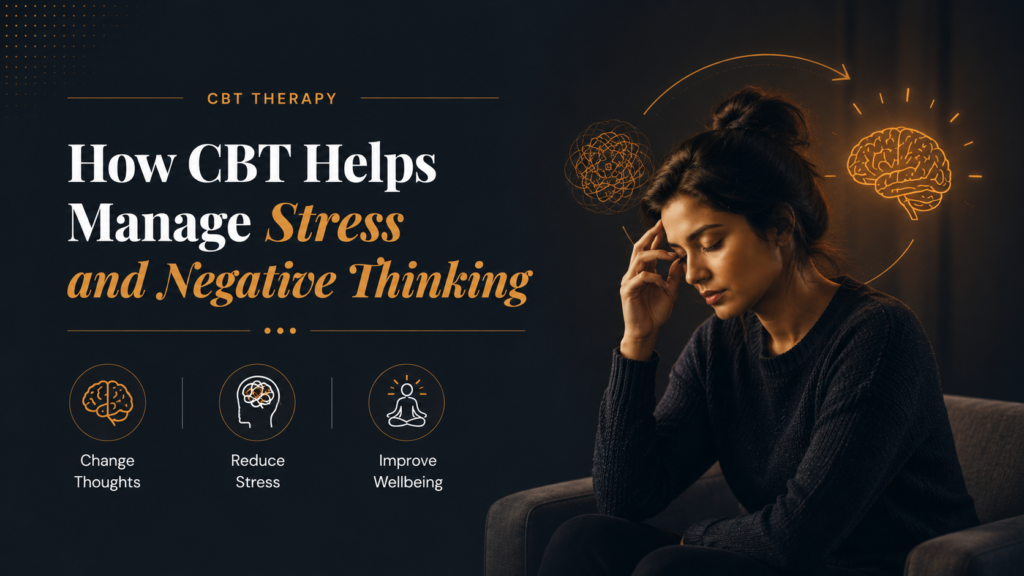
How CBT Helps Manage Stress and Negative Thinking
If your mind keeps looping through worry or self-criticism, there is a well-tested, practical way out. Ms. Shweta Mittal at Shweta Heals explains how cognitive behavioural therapy actually works in anxiety counselling and depression counselling.
01When Your Own Mind Feels Like the Problem
A reflection from Ms. Shweta Mittal before we explore how CBT actually works
“I know logically that everything is fine. But my brain just won’t stop telling me something terrible is about to happen.”
I hear some version of this in nearly every anxiety counselling session, and often in depression counselling too, just framed differently — “I know I should feel grateful, but I just feel numb and like nothing matters.” In both cases, there is a painful gap between what a person knows intellectually and what their mind keeps insisting emotionally. This gap is exactly where cognitive behavioural therapy, commonly known as CBT, does its most important work.
CBT is one of the most extensively researched and consistently effective approaches available for stress, anxiety, and negative thinking patterns. It does not ask you to simply think positive or push difficult feelings aside. Instead, it gives you a structured, practical way to examine your own thinking honestly — and that honesty is usually what creates lasting change.
Cognitive behavioural therapy helps manage stress and negative thinking by teaching individuals to identify the specific thought patterns that drive distress, examine the evidence for and against those thoughts, and gradually replace distorted or unhelpful thinking with more balanced, realistic perspectives. This process reduces the intensity and frequency of stress responses over time, because the thoughts that originally triggered them are directly addressed rather than simply managed after the fact. Professional anxiety counselling and depression counselling at Shweta Heals use CBT as a core, evidence-based tool within a broader, personalised approach.
“CBT does not ask anyone to pretend things are fine. It asks a much more honest question — is this thought actually true, or just familiar? That distinction changes everything.”Ms. Shweta Mittal — Anxiety & Depression Counsellor, Shweta Heals, Faridabad
02Understanding the Thought–Feeling–Behaviour Cycle
The foundational idea that makes CBT so practical
CBT is built on a simple but powerful observation: thoughts, feelings, and behaviours are deeply interconnected, and each one influences the others continuously. A stressful thought produces a physical and emotional stress response, which then shapes behaviour, and that behaviour often reinforces the original thought, creating a self-sustaining cycle.
Thought
“Everyone in this meeting thinks I am unprepared and incompetent.”
Feeling
A surge of anxiety, racing heart, and a strong urge to avoid speaking up.
Behaviour
Staying silent, which then reinforces the belief of being unprepared, restarting the cycle.
CBT interrupts this cycle by working directly on the thought stage, since changing the initial interpretation of a situation tends to shift the feeling and behaviour that follow it. This is why CBT is considered so effective in both anxiety counselling and depression counselling — it targets the mechanism that sustains distress rather than only managing its symptoms.
03Common Negative Thinking Patterns CBT Addresses
Recognising these patterns is often the first relief a person feels
Negative thinking patterns, sometimes called cognitive distortions, are habitual, often automatic ways of interpreting situations that are unrealistically negative. They tend to feel completely true in the moment, which is exactly why naming them clearly is so powerful.
Catastrophising
Assuming the worst possible outcome will happen, even when evidence does not support that conclusion. A minor mistake becomes “I am going to lose my job.”
All-or-Nothing Thinking
Viewing situations in extreme, binary terms with no middle ground — a single setback feels like complete failure rather than a partial result.
Mind Reading
Assuming you know what others are thinking, almost always negatively, without any actual evidence to support that assumption.
Overgeneralisation
Taking a single negative event and applying it broadly — one rejection becomes “nothing ever works out for me.”
04Why This Matters Specifically for Anxiety and Depression
The distinct but overlapping roles CBT plays in each
In anxiety counselling, negative thinking patterns typically centre around overestimating danger and underestimating one’s ability to cope, which sustains a persistent state of alertness and worry. In depression counselling, the patterns more often involve self-critical, hopeless interpretations of oneself, the world, and the future, which sustain low mood and withdrawal.
CBT addresses both by directly targeting the specific distortions involved, while also working on the behavioural side — reducing avoidance in anxiety, and countering withdrawal and inactivity in depression through a technique called behavioural activation. For a deeper look at how this applies specifically to anxiety, see our detailed guide: Best Therapist for Anxiety in Faridabad. For how this applies to depression recovery specifically, see our guide: How Therapy Helps Depression Recovery.
What I Want People to Understand About CBT
CBT is not about forcing positivity. It is about accuracy. Many of the thoughts that drive chronic stress, anxiety, and depression are not lies exactly — but they are distorted, exaggerated versions of reality that feel completely convincing in the moment.
The goal of CBT in both anxiety counselling and depression counselling is to help a person hold their own thoughts a little more loosely — to ask “is this actually true, or does it just feel true right now” — and from that small shift, genuinely significant change becomes possible.
05Practical CBT Techniques Used to Manage Stress
What actually happens inside a CBT-informed counselling session
-
1Cognitive restructuring: Identifying an automatic negative thought, examining the actual evidence for and against it, and arriving at a more balanced, realistic alternative. This is the central technique in most CBT-based sessions.
-
2Thought records: Writing down specific situations, the automatic thoughts they triggered, the resulting feelings, and an examined, more balanced response — making invisible patterns visible over time.
-
3Behavioural activation: Gradually re-engaging with meaningful or previously enjoyed activities, particularly important in depression counselling where withdrawal sustains low mood.
-
4Graded exposure: Gradually and safely facing avoided situations in anxiety counselling, building confidence and reducing avoidance one manageable step at a time.
-
5Relaxation and breathing techniques: Practical tools to manage the physical symptoms of stress and anxiety in the moment, complementing the cognitive work being done.
-
6Structured problem-solving: Breaking down overwhelming practical stressors into specific, manageable steps rather than letting them remain a vague, anxiety-provoking blur.
Worth remembering: CBT is collaborative and skills-based. A trained therapist guides the process, but the individual plays an active role throughout, which is part of why the skills learned tend to remain useful long after counselling sessions end.
06What CBT-Based Counselling at Shweta Heals Looks Like
A practical walkthrough of how this approach is applied in real sessions
Understanding Your Specific Patterns
Ms. Shweta Mittal begins by understanding the specific thoughts, situations, and patterns driving your stress, anxiety, or low mood, rather than applying a generic template to every individual.
Identifying Negative Thought Patterns
Together, you identify the specific cognitive distortions showing up most often in your thinking, making previously automatic patterns clearly visible.
Practising Cognitive Restructuring
Through guided practice, often using thought records, you learn to examine and challenge these thoughts in real situations, building the skill gradually.
Building Behavioural Strategies
Alongside the cognitive work, practical behavioural strategies are introduced, whether that means gradual exposure for anxiety or behavioural activation for depression.
Building Independence
Over time, the goal is for you to apply these CBT skills independently, so the benefits continue well beyond the structured counselling period itself.
07How Shweta Heals Supports This Journey
Professional counselling services for stress, anxiety, and negative thinking
Anxiety Counselling
CBT-informed support for anxiety, excessive worry, and stress-related thought patterns. Read our full guide on the best therapist for anxiety in Faridabad.
Depression Counselling
Structured support combining cognitive and behavioural techniques. Read our full guide on how therapy helps depression recovery.
Stress Management
Practical, evidence-based tools for chronic stress, work pressure, and overwhelming life transitions.
Relationship Counselling
For couples and individuals whose stress and negative thinking patterns are affecting their relationships.
Marriage Counselling
For couples experiencing stress and conflict patterns that benefit from cognitive and behavioural approaches.
Career Counselling
For work-related stress, performance anxiety, and the negative thought patterns around career decisions.
08What Clients Share
Real experiences from individuals across Faridabad who used CBT to manage stress and negative thinking
“I had no idea how often I was catastrophising until anxiety counselling with Ms. Shweta Mittal showed me the pattern clearly. Learning to question those thoughts has genuinely changed my daily life.”
“Depression counselling using behavioural activation got me moving again when I genuinely could not find any motivation on my own. Small steps, but they added up to something real.”
“Thought records felt strange at first but became one of the most useful tools I have ever learned. I still use them years later whenever stress starts building up.”
“Online anxiety counselling from Badarpur, and genuinely effective. CBT gave me practical tools rather than just talking about feelings, which is exactly what I needed.”
09Related Reading
More helpful guides from Shweta Heals on anxiety, depression & mental health
Best Therapist for Anxiety in Faridabad
How Therapy Helps Depression Recovery
What Happens During an Anxiety Attack?
Depression vs Sadness — What Is the Real Difference?
Understanding Anxiety — A Shweta Heals Perspective
Understanding Depression — Signs, Causes & Therapy
10Where We Serve
Faridabad (Sector 12)
Walk-in & appointment sessions at Parsvnath City Mall
NIT Faridabad
Anxiety & depression counselling sessions
Old Faridabad
In-person and online sessions available
Ballabhgarh
In-person or online CBT-based counselling
Badarpur
Online & in-person sessions for Badarpur area
Delhi NCR & Pan India
Online counselling anywhere in India
Visit Shweta Heals — Book an Anxiety or Depression Counselling Session
In-person & online CBT-based anxiety counselling and depression counselling — Faridabad, Delhi NCR & all of India. First enquiry is completely free.
11Conclusion — Your Thoughts Are Not Facts
Stress and negative thinking can feel like permanent features of who you are, but they are far more often learned patterns than fixed truths. Cognitive behavioural therapy offers a practical, structured, well-researched way to examine those patterns honestly and gradually build a more balanced relationship with your own mind.
Whether you are managing chronic stress, persistent anxiety, or the negative, self-critical thinking that often accompanies depression, CBT provides tools that genuinely work and continue working long after counselling sessions end. Ms. Shweta Mittal and the team at Shweta Heals bring this evidence-based approach into every anxiety counselling and depression counselling session, tailored to your specific patterns and needs. Reach out today — the first conversation is completely free and entirely confidential.
Your Mind Can Learn New Patterns
Book an anxiety counselling or depression counselling session with Ms. Shweta Mittal — in person at Sector 12 Faridabad or online across India. First enquiry is completely free.
?Frequently Asked Questions
Real questions individuals ask Ms. Shweta Mittal about CBT, stress, and counselling at Shweta Heals Faridabad.
Cognitive behavioural therapy, commonly known as CBT, helps manage stress and negative thinking by teaching individuals to identify the specific thought patterns that drive distress, examine the evidence for and against those thoughts, and gradually replace distorted thinking with more balanced perspectives. This reduces the intensity and frequency of stress responses over time.
CBT is a structured, practical form of talk therapy based on the principle that thoughts, feelings, and behaviours are closely connected, and that changing unhelpful thought patterns can directly reduce emotional distress. It is largely present-focused and skills-based, making it especially effective for stress, anxiety counselling, and negative thinking.
Negative thinking patterns, or cognitive distortions, are habitual ways of interpreting situations that are unrealistically negative, such as assuming the worst or seeing things in all-or-nothing terms. CBT identifies these by helping individuals slow down and examine their automatic thoughts, often through thought records, making the pattern visible and changeable.
Yes. While CBT is widely used for anxiety counselling and depression counselling, its techniques are equally effective for chronic stress that does not meet criteria for a specific diagnosis. Patterns such as catastrophising respond very well to the same cognitive restructuring techniques used clinically.
Common CBT techniques include cognitive restructuring to challenge unhelpful thoughts, behavioural activation to counter avoidance, relaxation and breathing techniques, structured problem-solving, and exposure-based techniques for specific feared situations. A trained therapist tailors the combination to the individual.
CBT is fundamentally different from positive thinking. Positive thinking asks a person to replace negative thoughts with optimistic ones regardless of evidence. CBT instead teaches examining the actual evidence for and against a thought to arrive at a balanced, realistic conclusion that is accurate to the situation.
CBT is highly effective for anxiety counselling because anxiety is largely driven by specific thought patterns such as overestimating danger. CBT directly targets these patterns while addressing avoidance behaviours that maintain anxiety, which is part of why it remains one of the most evidence-supported approaches. Read more: Best Therapist for Anxiety in Faridabad.
In depression counselling, CBT helps identify negative, self-critical, and hopeless thought patterns that sustain depressive episodes, while using behavioural activation to counter withdrawal and inactivity. Read more: How Therapy Helps Depression Recovery.
Cognitive restructuring involves identifying an automatic negative thought, examining the evidence supporting and contradicting it, considering alternative explanations, and arriving at a more balanced thought. With repeated practice, this becomes a more natural habit that reduces stress and negative emotional reactions.
CBT is generally a shorter-term, structured approach compared to some other therapies, often involving a defined number of sessions focused on specific goals. However, the skills learned are designed to be used independently long after therapy ends, extending its benefits well beyond active treatment.
Yes. CBT is frequently used alongside medication, and research generally supports this combination as effective for many individuals, particularly for more severe symptoms. The decision about medication should be made with a qualified medical professional, while CBT focuses on psychological and behavioural dimensions.
Many individuals notice meaningful shifts within 6 to 12 sessions of CBT, though this varies based on severity and individual circumstances. Ms. Shweta Mittal at Shweta Heals creates a personalised treatment plan after assessing each individual’s needs.
A typical session begins with a brief check-in and homework review, followed by focused work on specific thoughts or behaviours relevant to your goals. Sessions are collaborative and structured, often including exercises such as thought records, with the individual playing an active role.
Yes. CBT is commonly used for work-related stress and burnout by helping individuals identify unhelpful thought patterns around performance and perfectionism, while developing practical coping and boundary-setting skills. Many seeking anxiety counselling for work stress find CBT particularly applicable.
CBT is suitable for a wide range of individuals, but it is not universally the best fit for every situation. Some individuals benefit more from approaches focusing on past experiences or trauma, sometimes used alongside CBT. A qualified counsellor can help assess the most appropriate approach for your needs.
Signs include persistent worry or low mood lasting more than two weeks, difficulty functioning in daily responsibilities, withdrawal from previously enjoyed activities, and physical symptoms like sleep disruption without a clear medical cause. A qualified therapist can help clarify which support best matches your experience.
Ms. Shweta Mittal at Shweta Heals is widely regarded as the best therapist for anxiety counselling and depression counselling in Faridabad, with 10+ years of experience and 5,00,000+ sessions conducted using evidence-based approaches including CBT. Read more: Best Therapist for Anxiety in Faridabad.
Therapy helps depression recovery by addressing both the negative thought patterns that sustain low mood and the behavioural withdrawal that often accompanies depression, using structured approaches such as CBT alongside compassionate, personalised support. Read more: How Therapy Helps Depression Recovery.
Yes. Shweta Heals offers both in-person CBT-informed anxiety counselling and depression counselling at Parsvnath City Mall, Sector 12, Faridabad, and fully effective online sessions across Ballabhgarh, Badarpur, NIT Faridabad, Old Faridabad, Delhi NCR, and all of India.
Absolutely. All counselling sessions at Shweta Heals, including anxiety counselling and depression counselling using CBT techniques, are 100% confidential, creating the safety needed to honestly explore thought patterns without fear of judgment.
Visit shwetaheals.com/contact, fill the contact form, or call +91 85879 98559. Also reachable at shwetaheals@gmail.com. Sessions at Space Center, TF-01, 3rd Floor, Parsvnath City Mall, Sector 12, Faridabad – 121007. Online sessions available Pan India. First enquiry is completely free and confidential.