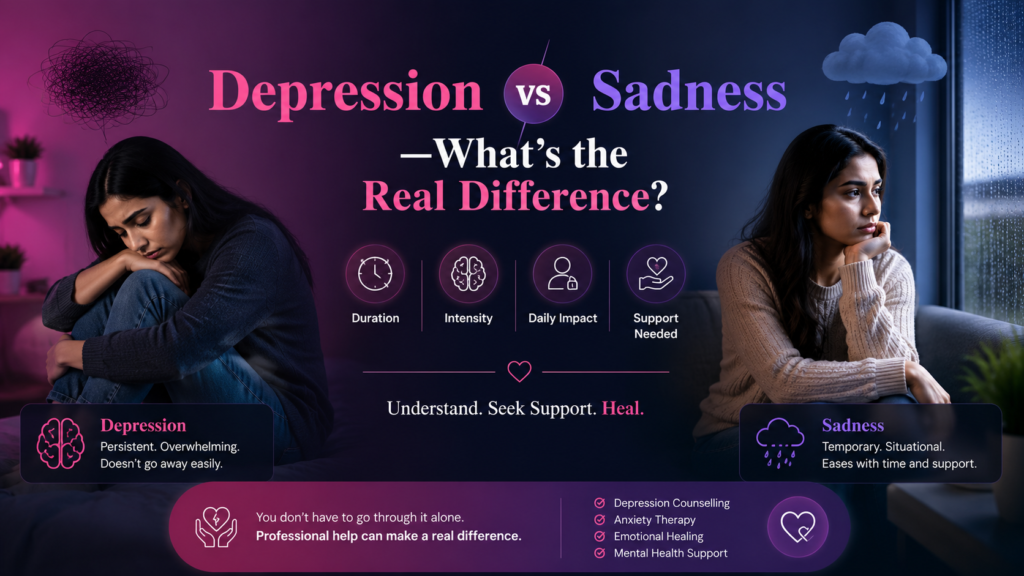
Depression vs Sadness —
What’s the Real Difference?
Not everything that feels heavy is depression — but depression always deserves to be taken seriously. A complete, honest guide to understanding the difference, recognising the signs, and finding the right help from the best counsellor for depression in Faridabad.
We all feel sad sometimes. It is a natural, healthy, deeply human part of life. But when that sadness doesn’t lift — when it settles in like a fog that colours every thought, drains every morning of energy, and makes even small tasks feel impossible — something else may be happening. Understanding the difference between depression and sadness is not just academically important. It can be the difference between getting the right help and suffering alone for months or years. At Shweta Heals, the best counsellor for depression in Faridabad, Ms. Shweta Mittal has helped thousands of individuals across Faridabad, Ballabhgarh, Badarpur, and Delhi NCR find clarity — and healing.
What Is Sadness?
Understanding the most natural of all human emotions
Sadness is a fundamental, universal human emotion. It is the natural emotional response to loss, disappointment, failure, rejection, grief, or any experience that matters to us but does not go the way we hoped. Sadness is not only normal — it is healthy. It signals to us and to those around us that something we care about has been hurt, lost, or changed.
When you feel sad after a breakup, the loss of a loved one, a professional setback, or a deeply disappointing outcome — that sadness is proportionate. It makes sense. It is your emotional system working exactly as it should — processing, grieving, and beginning to adapt.
Crucially, sadness is temporary and responsive. It tends to lift as circumstances change, as time passes, as you receive support, or as you process and make sense of what happened. Even in deep grief, there are usually moments of respite — memories that bring warmth, conversations that bring comfort, mornings that feel slightly lighter.
“Sadness is not your enemy. It is one of the most honest signals your heart can send — telling you that something mattered.”Ms. Shweta Mittal — Counsellor & Founder, Shweta Heals, Faridabad
What Is Depression?
Understanding depression as a clinical condition — not a personal failure
Depression — clinically known as Major Depressive Disorder (MDD) — is a serious mental health condition characterised by a persistent, pervasive low mood that lasts for weeks or months, significantly impairs daily functioning, and does not resolve simply because circumstances change. Depression is not “just feeling sad.” It is not weakness, self-pity, or a choice. It is a genuine medical condition that affects the brain, body, and behaviour simultaneously.
In India — and particularly in cities like Faridabad and Delhi NCR — depression is significantly underdiagnosed because of the cultural expectation to “push through” difficult feelings, the social stigma attached to mental health conditions, and the widespread lack of awareness about what depression actually looks like in everyday life. Many individuals carry depression silently for months or years, believing they are simply going through a difficult phase, or that seeking help is a sign of weakness.
Both beliefs are wrong. Depression is a condition. And professional counselling — especially with an experienced, compassionate counsellor like Ms. Shweta Mittal at Shweta Heals — is one of the most effective treatments available.
Depression vs Sadness — The Key Differences
A clear, practical comparison to help you understand what you or someone you love may be experiencing
| Factor | 🌧️ Depression | 😢 Sadness |
|---|---|---|
| Duration | Persistent — lasts 2+ weeks or much longer | Temporary — eases with time and support |
| Trigger | May have no clear cause or be disproportionate to circumstances | Usually linked to a specific event or loss |
| Mood | Pervasive emptiness, numbness, or hopelessness | Specific to the situation; moments of relief exist |
| Interest | Loss of interest in all previously enjoyed activities (anhedonia) | Can still find moments of joy or distraction |
| Self-worth | Persistent feelings of worthlessness, guilt, failure | Self-worth remains broadly intact |
| Physical impact | Fatigue, sleep disruption, appetite changes, physical pain | May feel upset but physical functioning largely intact |
| Functioning | Significantly impairs work, relationships, daily tasks | Can still manage daily responsibilities |
| Thoughts | Negative, repetitive, difficult to control — sometimes thoughts of death | Sad thoughts but generally rational and manageable |
| Resolution | Does not resolve on its own; needs professional support | Resolves naturally with time, support, or changed circumstances |
⚠️ If you are unsure whether what you are experiencing is sadness or depression — that uncertainty itself is a reason to seek a professional assessment. A qualified counsellor can provide clarity, reassurance, and a path forward. At Shweta Heals, the first enquiry is completely free and confidential. Reach out today.
Signs and Symptoms of Depression
Recognising depression before it deepens — the signs that deserve professional attention
Depression presents differently in different people. It is not always the dramatic, visible breakdown that popular culture depicts. Often it looks like someone who is still functioning — going to work, attending social events, smiling — but who feels profoundly empty inside. Here are the core signs:
Persistent Low Mood or Emptiness
A pervasive sense of sadness, emptiness, or emotional numbness that lasts most of the day, nearly every day, for two weeks or more — not linked to a specific cause.
Loss of Interest or Pleasure
Activities, hobbies, relationships, and experiences that previously brought genuine joy no longer seem to matter or generate any emotional response. This is called anhedonia.
Sleep Disturbances
Persistent insomnia — inability to fall or stay asleep — or hypersomnia — sleeping excessively but still feeling completely exhausted and unrested.
Fatigue and Loss of Energy
A profound, pervasive tiredness that is not resolved by rest — making even simple daily tasks feel like enormous effort requiring deliberate willpower.
Changes in Appetite and Weight
Significant increase or decrease in appetite — leading to unintentional weight gain or loss — without making conscious dietary changes.
Difficulty Concentrating
Inability to focus, think clearly, make decisions, or remember things — affecting work performance, study, and even basic daily planning.
Feelings of Worthlessness or Guilt
Persistent, disproportionate feelings of being fundamentally inadequate, a burden to others, or deserving of suffering — even without specific cause.
Social Withdrawal
Pulling away from friends, family, and social situations — not out of preference for solitude but because connecting with others feels exhausting or pointless.
If you or someone you love is experiencing five or more of these symptoms consistently for two weeks or more, professional assessment is strongly recommended. Read our detailed guide on understanding depression — signs, causes, and the power of therapy for a deeper exploration.
What Causes Depression?
Depression rarely has a single cause — it emerges from a combination of factors
Brain Chemistry
Imbalances in neurotransmitters — particularly serotonin, dopamine, and norepinephrine — play a significant role in the onset of depressive episodes.
Genetics & Family History
A family history of depression significantly increases risk — though having a genetic predisposition does not make depression inevitable.
Trauma & Adverse Experiences
Childhood trauma, abuse, neglect, or significant adverse life events create neurological and psychological vulnerabilities that increase depression risk.
Relationship & Social Stress
Toxic relationships, marital breakdown, loneliness, social isolation, and persistent interpersonal conflict are among the most common depression triggers.
Life Transitions & Loss
Major life changes — job loss, grief, divorce, financial stress, migration — can trigger depressive episodes, particularly when support systems are inadequate.
Negative Thought Patterns
Chronic negative thinking — catastrophising, self-blame, perfectionism — creates cognitive frameworks that feed and sustain depressive states over time.
How to Deal With Depression — A Step-by-Step Guide
Practical, evidence-based steps that create genuine, lasting improvement
Acknowledge and Name What You Are Experiencing
The first and most important step is to stop minimising what you feel. Depression is not “just a phase,” weakness, or something you should be able to control through willpower. Naming it honestly — to yourself and ideally to someone you trust — is the foundation of everything that follows. Many individuals in Faridabad and Delhi NCR carry depression silently for years out of shame. You do not have to.
Seek Professional Counselling Support
Professional counselling is the single most effective evidence-based intervention for depression — particularly mild to moderate depression. A skilled counsellor like Ms. Shweta Mittal at Shweta Heals helps you understand the root causes of your depression, challenge the negative thought patterns sustaining it, rebuild emotional functioning, and develop practical coping strategies that work in your real life.
Establish Simple Daily Structure
Depression dismantles routine — and the absence of structure deepens depression in a reinforcing cycle. Even small, consistent daily anchors — a fixed wake time, a short walk, a meal at the same hour — create the neurological and psychological scaffolding that supports gradual recovery. Your counsellor will help you build a structure that is realistic for your current state.
Address Relationship and Social Factors
Depression does not exist in isolation from the rest of life. Toxic relationships, marital stress, loneliness, and poor communication all both contribute to and deepen depression. Addressing these — through relationship counselling or marriage counselling in parallel with individual support — produces far more comprehensive healing than addressing either in isolation.
Physical Health as a Foundation for Mental Health
Sleep, nutrition, hydration, and movement are not peripheral to depression recovery — they are foundational to it. Even gentle daily physical activity has been shown to have a meaningful positive impact on depressive symptoms. Your counsellor will help you identify realistic, sustainable lifestyle changes that support your mental health recovery.
Build a Support System and Stay Connected
Isolation is both a symptom and a driver of depression. Deliberately maintaining connection — however small and imperfect — with trusted people in your life is an important part of recovery. If relationships are strained, counselling can help repair and strengthen them as part of a comprehensive healing journey. Read more: coping with suicidal thoughts — how timely support can save lives.
Best Counsellor for Depression in Faridabad — Why Shweta Heals
Trusted by thousands of individuals across Faridabad, Ballabhgarh, Badarpur & Delhi NCR
10+ Years Specialist Experience
Over a decade of professional counselling experience across depression, anxiety, relationship challenges, career confusion, and holistic mental health — providing depth that makes a genuine difference.
10,000+ Sessions Delivered
Thousands of individuals and couples across Faridabad, Ballabhgarh, Badarpur, NIT Faridabad, Old Faridabad, and Delhi NCR have found clarity and healing through Shweta Heals.
Completely Personalised Approach
No generic frameworks or one-size-fits-all plans. Every counselling journey at Shweta Heals is built specifically around the individual’s unique history, situation, and goals.
100% Confidential & Safe
Absolute confidentiality in every session — creating the genuine psychological safety that is essential for honest, productive, and transformative therapeutic work.
Trusted Female Counsellor
Many individuals — particularly women — feel significantly more comfortable with a trusted female counsellor who combines professional expertise with genuine empathy and deep cultural understanding.
Online & In-Person — Maximum Access
Both in-person sessions at the Faridabad clinic and online sessions for individuals across Delhi NCR and all of India — with equal professional quality and complete confidentiality in both formats.
What Our Clients Say
Real experiences from individuals who found their way through depression with Shweta Heals
“I had been feeling low for almost a year and kept telling myself it would pass. It didn’t. After just three sessions with Shweta ma’am, I finally understood what I was going through was depression — not weakness. She gave me tools that actually worked in my real daily life. Genuinely life-changing.”
“Shweta Heals helped me more than I can put into words. I was completely withdrawn, couldn’t sleep, had stopped enjoying anything. Shweta ma’am was so non-judgmental and practical. Six months later I genuinely feel like myself again. I recommend her to everyone I know who is struggling.”
“I was sceptical about counselling but my family insisted. Best decision I ever made. She helped me understand the difference between what I was feeling and what it actually meant clinically. The online sessions were so convenient — I could attend from home without anyone knowing.”
“Shweta ma’am is exceptional. My husband and I both came in for counselling — him for depression, me for the stress of watching him struggle. She helped us both, individually and together. Our home is completely different now. Warm, communicative, and full of hope again.”
Other Professional Services at Shweta Heals
Stress & Anxiety Counselling
Professional support for anxiety, overthinking, panic, and chronic stress — often closely linked to depression.
Relationship Counselling
Addressing relationship difficulties that frequently both trigger and sustain depressive episodes.
Marriage Counselling
Professional support for married couples navigating emotional challenges, communication breakdown, and mental health together.
Career Counselling
Career confusion and professional dissatisfaction are common depression contributors. Guidance for students and adults.
Related Reading
Understanding Depression — Signs, Causes & the Power of Therapy
AnxietyUnderstanding Anxiety — A Shweta Heals Perspective
FaridabadBest Therapist for Anxiety in Faridabad
AnxietyWhat Happens During an Anxiety Attack?
Mental HealthCoping With Suicidal Thoughts — How Timely Support Saves Lives
RelationshipsWhat Is a Toxic Relationship? Signs, Causes & How to Heal
Areas We Serve
📍 Visit or Contact Shweta Heals
Confidential depression counselling — in-person in Faridabad & online across India
Final Thoughts
The difference between depression and sadness is not about how strong or weak you are. It is not about how much you have to be grateful for. It is not about your willpower or your perspective. It is about what is happening in your brain, your body, and your life — and what kind of support will genuinely help.
If you have read this far and recognised yourself — or someone you love — in what has been described, please do not wait. The sooner depression is addressed with professional support, the faster and more completely recovery happens. At Shweta Heals, Ms. Shweta Mittal offers the compassionate, expert, and completely personalised counselling support that makes genuine healing possible — for individuals across Faridabad, Ballabhgarh, Badarpur, NIT Faridabad, and all of Delhi NCR.
You do not have to keep feeling this way. Reach out today — your first conversation is completely free and confidential.
You Don’t Have to Feel This Way Forever
Book a confidential session with the best counsellor for depression in Faridabad — in-person at Sector 12 or online across India. First enquiry is free.
Frequently Asked Questions
Clear, honest answers about depression, sadness, and getting the right support in Faridabad.
Sadness is a normal, temporary emotional response to a difficult life event — it lifts as circumstances change or with time and support. Depression is a persistent clinical condition lasting weeks or months, affecting every area of life, and does not resolve simply because circumstances improve. Depression is characterised by pervasive low mood, loss of interest in all activities, physical symptoms, and a sense of hopelessness that sadness does not carry.
Depression is a serious mental health condition characterised by persistent feelings of sadness, emptiness, or hopelessness lasting two weeks or more — combined with symptoms like loss of interest in previously enjoyed activities, fatigue, difficulty concentrating, changes in sleep and appetite, feelings of worthlessness, and in severe cases, thoughts of self-harm. Depression is not a sign of weakness — it is a medical condition that responds well to professional counselling.
Sadness is a natural, healthy human emotion that arises in response to loss, disappointment, failure, or difficult life events. It is typically temporary, proportionate to the situation, and resolves as circumstances change or with time and support. Sadness does not prevent a person from functioning, experiencing moments of joy, or engaging with daily life the way depression does. Feeling sad is not a sign that something is wrong with you.
Ask yourself: Has the low mood lasted more than two weeks? Does it affect your ability to work, sleep, eat, or maintain relationships? Have you lost interest in everything you previously enjoyed? Do you feel pervasive worthlessness or hopelessness disconnected from any specific cause? If yes to several of these, professional assessment is strongly recommended. A qualified counsellor provides clarity, reassurance, and a path forward. At Shweta Heals, the first enquiry is completely free.
The main signs include persistent low mood or emptiness lasting 2+ weeks, loss of interest in previously enjoyed activities (anhedonia), significant sleep changes (insomnia or oversleeping), fatigue and loss of energy, changes in appetite and weight, difficulty concentrating or making decisions, feelings of worthlessness or excessive guilt, social withdrawal, and in severe cases, thoughts of death or self-harm. Five or more of these symptoms for two weeks or more warrants professional assessment.
Yes. Professional counselling is highly effective for mild to moderate depression — often without requiring medication at all. At Shweta Heals, Ms. Shweta Mittal uses personalised counselling approaches to address root causes, challenge negative thought patterns, rebuild self-worth, and restore emotional functioning. For severe depression, collaboration with a psychiatrist for medication support may also be recommended alongside counselling.
Ms. Shweta Mittal at Shweta Heals is widely regarded as one of the best counsellors for depression in Faridabad. With 10+ years of professional experience, 10,000+ sessions, and a deeply personalised, compassionate approach, she helps individuals across Faridabad, NIT Faridabad, Ballabhgarh, Badarpur, and Delhi NCR understand and heal from depression — through in-person and online sessions.
Depression is caused by a combination of biological factors (brain chemistry, genetics), psychological factors (negative thought patterns, low self-worth, trauma), and social factors (relationship difficulties, isolation, stress, grief, financial pressure, and major life transitions). In most cases, multiple factors work together rather than a single cause being responsible — which is why personalised counselling is so effective in addressing it comprehensively.
Yes. If intense sadness — particularly following significant loss, trauma, or prolonged life stress — is not processed and supported adequately, it can develop into clinical depression over time. This is one of the most important reasons to seek professional support early, rather than waiting and hoping things will improve on their own. Early intervention consistently produces better and faster outcomes.
Yes. Shweta Heals offers both in-person depression counselling at the Faridabad centre (Space Center, TF-01, 3rd Floor, Parsvnath City Mall, Sector 12) and fully effective online sessions for individuals across Ballabhgarh, Badarpur, NIT Faridabad, Old Faridabad, Delhi NCR, and all of India. All services are delivered with equal quality and complete confidentiality in both formats.
Most individuals begin experiencing meaningful improvement in mood, energy, and functioning within 4 to 8 counselling sessions — depending on severity and duration of depression. Full recovery is an individual journey. Your counsellor creates a personalised plan after the first session and reviews progress regularly, adjusting the approach as you improve. Recovery is real — and with professional support, it happens far faster than waiting alone.
Grief is a natural response to loss — it comes in waves, typically includes positive memories, and gradually eases over time. Depression is more pervasive, does not improve with time alone, involves persistent worthlessness rather than just sadness about a loss, and affects overall functioning more broadly. However, grief can trigger depression — making professional support particularly important after significant loss, especially when grief does not ease after several months.
Yes. Relationship difficulties — including toxic relationships, marital breakdown, loneliness, and emotional isolation — are among the most common triggers of depression. Addressing both the relationship challenges and the resulting depression together, through relationship counselling and individual support simultaneously, produces the most comprehensive and lasting healing. Read more: What Is a Toxic Relationship?
Absolutely not. Depression is a medical condition — not a character flaw, a personal failure, or a sign of weakness. It can affect anyone regardless of strength, intelligence, success, or circumstance. Many of the world’s most accomplished individuals have experienced depression. Seeking help for depression is not weakness — it is one of the most courageous and self-aware things a person can do.
Listen without judgment. Avoid minimising their experience with phrases like “just think positive” or “others have it worse.” Gently and consistently encourage professional support. Practical help — accompanying them to seek counselling, assisting with daily tasks — can make a significant difference. At Shweta Heals, family members are welcome to participate in the process with the individual’s consent. You can call +91 85879 98559 to discuss the situation confidentially first.
Visit shwetaheals.com/contact, fill the contact form, or call +91 85879 98559. You can also email shwetaheals@gmail.com. In-person sessions at Space Center, TF-01, 3rd Floor, Parsvnath City Mall, Sector 12, Faridabad – 121007. Online sessions available Pan India. First enquiry is completely free and confidential.